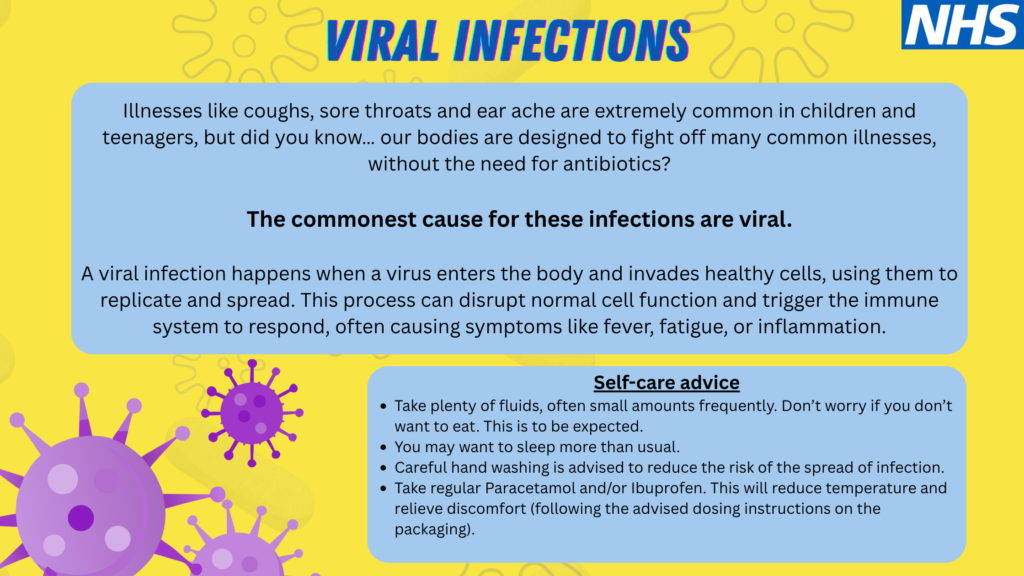
These common ailments and can be unpleasant for children and their caregivers but are most often caused by viral infections and do not need to be treated with antibiotics.
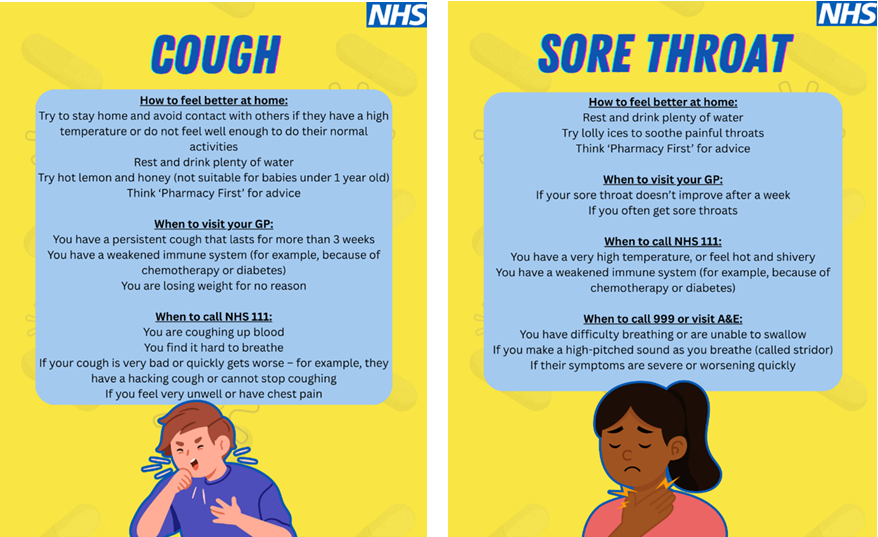
You know your body best, so do seek medical help if you are concerned about your symptoms, or if you feel your body needs a bit more support because you are immunosuppressed or have other existing medical conditions.
Keeping antibiotics working for those in need
Common illnesses such as coughs, ear ache and sore throats don’t usually need treating with antibiotics, and you will get better without taking unnecessary medication.
In fact, antibiotics are no longer routinely used to treat most infections, because:
- Many infections in children are caused by viruses, so antibiotics are not effective
- Antibiotics are often unlikely to speed up the healing process
- Antibiotics can cause unwanted side effects for your child, such as rash and diarrhoea
- The more often antibiotics are used to treat minor conditions, the more likely they are to become ineffective for treating more serious conditions
Find out more by clicking here
Antibiotic resistance
Overuse of antibiotics means they’re becoming less effective against bacteria and this has led to the emergence of ‘super bugs’. These are strains of bacteria that have developed resistance to many different types of antibiotics.
They can be serious and challenging to treat, and are becoming an increasing cause of disability and death across the world.
Find out more about antibiotic resistance and ‘super bugs’ here.
What’s the evidence?
A list of articles which provide the evidence for these statements has been provided below for those who would like more information. They have all been published in respected scientific journals and undergone a peer review process as part of this, which is a quality control process to ensure that reliable, high-quality research is published.
- ARTIC PC Trial
ARTIC PC is a trial conducted across 56 GPs in England included children 6 months to 12 years with an acute uncomplicated chest infection (lower respiratory tract infection – there was no suspicion of pneumonia on clinical assessment) who were randomly assigned to either receive amoxillicin or a placebo tablet for 7 days.
The results showed there was no difference in the duration of symptoms rated as moderately bad or worse and no difference in the number of complications or rates of hospitalisation between both of these groups.
The trial concluded that safety-netting advice should be provided but antibiotics not prescribed for most children presenting with chest infections (unless pneumonia is suspected).
Click here to read more about the ARTIC PC Trial
2. PRISM study
The PRISM study compared clinical scoring systems or rapid antigen detection tests (RADTs) to a delayed prescription of antibiotics for patients attending primary care with acute sore throat.
FeverPAIN score is a clinical scoring system used by healthcare professionals to objectively calculate the likelihood of strep throat and need for antibiotic prescription. Rapid antigen tests are quick tests to detect the presence of Strep A in the throat.
The study found that targeted antibiotics using a clinical scoring system such as FeverPAIN compared to delayed antibiotic prescriptions efficiently improves symptoms and reduces antibiotic use.
RADTs in combination with FeverPAIN provided no clear advantage over FeverPAIN alone. Therefore, RADTs are not recommended and not routinely available for use in primary care as it is not cost effective to use them.
Click here to read more about the PRISM study
3. Risk of complication following respiratory tract infections
This was a look back study to identify the extent which antibiotics reduce the risk of serious complications after common respiratory tract infections (upper respiratory tract and chest infections, sore throat and otitis media – infection and inflammation of the middle ear).
This study found that serious complications (such as pneumonia, quinsy – an abscess around the tonsil and mastoiditis – inflammation in mastoid bone) were rare and the number of patients who needed to receive antibiotics to avoid one case of a complication was over 4,000 patients.
The study concluded that antibiotics are not justified to reduce the risk of serious complications for upper respiratory tract infection, sore throat or otitis media unless there were specific indications to do so, as identified by a healthcare professional.
4. Addressing Consumer Misconceptions on Antibiotic Use and Resistance in the Context of Sore Throat: Learnings from Social Media Listening
This article explored consumer conversations on social media platforms on antibiotic use and antibiotic resistance for sore throats.
They identified five different groups of people including antibiotic-preserving peer educators, believers in the strength of antibiotics and determined pro-antibiotic consumers to name a couple.
It was found that many opinions across all groups were based on misconceptions. The most prominent misconception was that antibiotics are a strong medication that can treat all types of sore throat.
It found that consumers sought multiple routes to access antibiotics and approaches are required to dispel consumer misconceptions about the effectiveness of antibiotics.
Campaign resources
Winter virus campaign poster 1
Winter virus campaign poster 2
Winter virus campaign poster 3
Winter virus campaign poster 1 Arabic
Winter virus campaign poster 2 Arabic
Winter virus campaign poster 3 Arabic
Winter virus campaign poster 1 Bengali
Winter virus campaign poster 2 Bengali
Winter virus campaign poster 3 Bengali
Winter virus campaign poster 1 Polish
Winter virus campaign poster 2 Polish
Winter virus campaign poster 3 Polish
Winter virus campaign poster 1 Punjabi
Winter virus campaign poster 2 Punjabi
Winter virus campaign poster 3 Punjabi
Winter virus campaign poster 1 Romanian
Winter virus campaign poster 2 Romanian
Winter virus campaign poster 3 Romanian
Winter virus campaign poster 1 Tigrinya
Winter virus campaign poster 2 Tigrinya
Winter virus campaign poster 3 Tigrinya
Winter virus campaign poster 1 Urdu